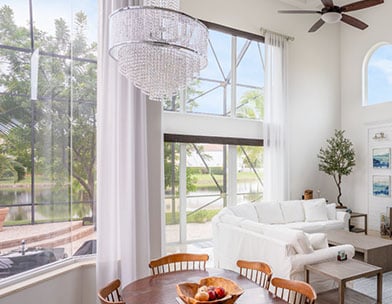
If you own a home in Florida, you already know two things are certain every year: hurricane season and a homeowners insurance bill that keeps climbing. The good news is that the same upgrade that protects your family from a storm can also lower what you pay to insure your home. Impact windows are one of the few improvements that pay you back twice, once in safety and again in premium savings.
Florida law requires property insurers to give homeowners credit for approved storm-protection features. Understanding how those credits work, which products qualify, and how the inspection is documented puts you in a strong position to make a smart decision about your home.
How wind mitigation credits actually work
After the destructive hurricane seasons of the 1990s and 2000s, the Florida Legislature required property insurers to reward homeowners who reduce their storm risk. These rewards are called wind mitigation credits, and they are tied directly to features that keep a building intact during high winds.
The weakest points in any house are its openings. During a hurricane, wind-driven debris can shatter ordinary glass in an instant. Once a window breaks, pressurized air rushes inside and has nowhere to go. That pressure pushes up on the roof and out on the walls, which is how many homes come apart in a storm. Protect the openings and you protect the whole structure, and that lower risk is exactly what your insurer is paying you to create.
What makes a window qualify
Thicker glass alone does not earn a credit. Qualifying products have to pass the testing standards written into the Florida Building Code. In the High-Velocity Hurricane Zone, which covers Miami-Dade and Broward counties, those standards are the strictest in the country.
Impact-resistant windows use reinforced aluminum or vinyl frames and laminated glass: two panes bonded to a tough clear interlayer, usually polyvinyl butyral (PVB). When debris strikes, the outer pane may crack, but the interlayer holds the fragments together and keeps wind and water out. To be recognized for insurance credits, a product must carry a Florida Product Approval number or a Miami-Dade Notice of Acceptance.
Those approvals come from real testing. A Large Missile Impact test fires a nine-pound 2x4 at the glass at roughly 50 feet per second, followed by thousands of pressure cycles that mimic the relentless push and pull of hurricane winds. Look for these ratings, often summarized as a Design Pressure (DP) value, when you compare impact windows.
The all-or-nothing rule
Many homeowners assume that protecting a few windows earns a partial discount. In practice, the opening protection credit is generally all-or-nothing. To claim the full premium reduction, every glazed opening on the home has to be protected.
That means all windows, glass block, skylights, and any exterior door with glass must be impact-rated or covered by an approved system. Solid entry doors and garage doors also have to meet wind-load and impact requirements. If a single bathroom window is left unprotected, an insurer can deny the comprehensive credit, so plan the project as a whole rather than piece by piece.
Impact glass versus plywood and shutters
Insurers favor protection that works without anyone having to lift a finger. It helps to see why.
- Plywood is a last-minute measure. It takes labor to put up before every storm, blacks out the house, has to be stored all year, and earns no insurance benefit.
- Metal panel and accordion shutters can qualify for credits when installed on every opening, but they only protect you if someone is home to deploy them. If you travel during the season, that is a real gap.
- Impact glass is permanent and passive. Once installed, it guards the home day and night with nothing to deploy and nothing to store.
That always-on protection is a large part of why impact products tend to deliver the strongest and most reliable insurance credit.
Choosing styles that fit your home
Storm protection used to mean bulky shutters and metal grates. That is no longer the trade-off. Impact-resistant glass is now built into nearly every style, so you can secure the home without changing the look you want.
Single-hung and double-hung windows suit traditional homes. Casement windows crank open for full airflow and seal tightly against wind-driven rain. Sliding windows fit wide horizontal openings, and fixed picture windows are naturally strong because they do not open. For patios, impact-rated French doors and sliding glass doors let in light while keeping the building envelope sealed.
The wind mitigation inspection
Installing the right products is only half the job. To collect your credit, you need documentation, and that comes from a wind mitigation inspection.
A licensed inspector, contractor, engineer, or architect visits the home and completes the state's standard OIR-B1-1802 form. For opening protection, the inspector checks each window and door for permanent glass etchings, manufacturer labels, and the Florida Product Approval or Miami-Dade NOA that confirms the impact rating. Because the credit depends on clean documentation, proper permitting and code-compliant installation matter as much as the glass itself. When the paperwork is in order, the inspector can verify the work quickly and your carrier can apply the credit without delay.
The benefits you feel every day
Lower premiums get the attention, but they are only part of the return. Impact windows work for you year-round.
- Lower energy bills. Insulated glass with Low-E coatings reflects the sun's heat, keeps indoor temperatures steady, and eases the load on your air conditioner through a long Florida summer.
- A quieter home. The same laminated glass that stops debris also dampens outside noise from traffic, neighbors, and nearby airports.
- Better security. Laminated glass and heavy frames are far harder to break through, adding a layer of everyday protection against intruders.
Installation is what makes it all hold
Even the best window can fail if it is installed poorly, and a failed installation can void the very insurance benefit you were chasing. Correct anchoring, proper permits, and adherence to Florida code are what carry a window through the pressure of a real storm and through the inspection afterward.
At Aaron Windows, we install impact windows and doors built for Florida's coastal conditions and back the work with careful permitting and code-compliant installation, so your products perform when it counts and your wind mitigation paperwork holds up.
If you are ready to protect your home and start lowering your insurance premium, we would be glad to help. Contact Aaron Windows for a free quote and we will walk you through the right impact products, the inspection process, and the savings you can expect.